- Home
- Walking Tours
- Contact
- Blog
- Cathedral
- Popes: 1417-Present
-
St Peter's Basilica
- Altars
- Baldacchino
- Chair of St Peter
- Chapel of the Baptistery
- Chapel of the Blessed Sacrament
- Chapel of the Choir
- Chapel of the Pietà
- Crossing >
- Dome
-
Monuments
>
- Countess Matilda of Canossa
- Maria Clementina Sobieska
- Queen Christina of Sweden
- Pope Innocent VIII
- Pope Paul III
- Pope Gregory XIII
- Pope Gregory XIV
- Pope Leo XI
- Pope Urban VIII
- Pope Alexander VII
- Pope Clement X
- Pope Innocent XI
- Pope Alexander VIII
- Pope Innocent XII
- Pope Benedict XIV
- Pope Clement XIII
- Pope Pius VI
- Pope Pius VII
- Pope Leo XII
- Pope Pius VIII
- Pope Gregory XVI
- Pope Pius X
- Pope Benedict XV
- Pope Pius XI
- Pope Pius XII
- Pope John XXIII
- The Stuarts
- Mosaics
- Nave
- Portico >
- Statue of St Peter
- Statues of Founder Saints
- Transept
- Tribune
- St Peter's Square
-
Vatican Museums
- Borgia Apartment
- Braccio Nuovo
- Cappella Niccolina
- Courtyard of the Pinecone
- Gallery of the Candelabras
- Gallery of the Maps
- Gallery of the Tapestries
- Greek Cross Hall
- Picture Gallery
- Pius-Clementine Museum
- 'Raphael' Tapestries
- Room of the Immaculate Conception
- Sala di Costantino
- Sala dei Chiaroscuri
- Stanza della Segnatura
- Stanza di Eliodoro
- Stanza dell' Incendio
- Sistine Chapel
-
Fountains
- A Miscellany of Fountains
- Trevi Fountain
- Bernini's Fountains
- Fontana della Barcaccia
- Fontana della Peschiera
- Fontana Sallustiana
- Fountain in Piazza Colonna
- Fountain in Piazza delle Cinque Scole
- Fountain in Piazza dell' Aracoeli
- Fountain in Piazza Nicosia
- Fountain in Piazza di S.M. in Trastevere
- Fountain of Moses
- Fountain of Neptune
- Fountain of Ponte Sisto
- Fountain of the Acqua Paola
- Fountain of the Bees
- Fountain of the Cannonball
- Fountain of the Frogs
- Fountain of the Four Rivers
- Fountain of the Goddess Roma
- Fountain of the Lateran Obelisk
- Fountain of the Little Barrel
- Fountain of the Mask
- Fountain of the Moor
- Fountain of the Naiads
- Fountain of the Pantheon
- Fountains of Piazza Farnese
- Fountains of Piazza del Popolo
- Fountain of Piazza del Viminale
- Fountain of Piazza Mazzini
- Fountain of Ponte Sisto
- Fountain of the Porter
- Fountain of the Seahorses
- Fountains of St Peter's Square
- Fountain of the Triton
- Fountain of the Tritons
- Fountain of the Tureen
- Fountain of the Turtles
- Fountains of the Two Seas
- Fountains of Valle Giulia
- Four Fountains
- Rioni Fountains
- Street Fountains
- Venice Marries the Sea
- On This Day in Rome
-
Churches
- Top Ten Churches
- Map: Churches of Rome
- Churches by Rione
- Cosmatesque Pavements
- Deconsecrated Churches
- Funerary Monuments
- Little-known Churches
- Stations of the Cross
- 19th Century Churches >
- 20th Century Churches
- Chiesa dei Re Magi
- Chiesa del Gesù >
- Chiesa dell' Annunziatella
- Chiesa di Gesù e Maria
- Chiesa Nuova
- Domine Quo Vadis
- Lateran Baptistery
- Nostra Signora del Sacro Cuore
- S. Agata dei Goti
- S. Agata in Trastevere
- S. Agnese fuori le Mura
- S. Agnese in Agone
- S. Agostino
- S. Alessio
- S. Anastasia al Palatino
- S. Andrea al Quirinale
- S. Andrea della Valle
- S. Andrea delle Fratte
- S. Angelo in Pescheria
- S. Anna dei Palafrenieri
- S. Antonio dei Portoghesi
- S. Apollinare
- Ss. Apostoli
- S. Balbina
- S. Barbara dei Librai
- S. Bartolomeo all' Isola
- S. Benedetto in Piscinula
- S. Bernardo alle Terme
- S. Bibiana
- S. Brigida
- S. Carlo ai Catinari
- S. Carlo al Corso
- S. Carlo alle Quattro Fontane
- S. Caterina a Magnanopoli
- S. Caterina dei Funari
- S. Caterina da Siena
- S. Cecilia in Trastevere
- Ss. Celso e Giuliano
- Ss. Claudio e Andrea
- S. Clemente >
- Ss. Cosma e Damiano
- S. Crisogono
- S. Costanza
- S. Croce in Gerusalemme >
- Ss. Crocifisso
- Ss. Domenico e Sisto
- S. Dorotea
- S. Eligio dei Ferrari
- S. Eusebio
- S. Eustachio
- S. Francesco a Ripa >
- S. Francesca Romana
- S. Giacomo in Augusta
- S. Giorgio in Velabro
- S. Giovanni a Porta Latina
- S. Giovanni Decollato
- S. Giovanni dei Fiorentini
- S. Giovanni della Pigna
- Ss. Giovanni e Paolo
- S. Girolamo dei Croati
- S. Girolamo della Carità >
- S. Giuliano dei Fiamminghi
- S. Giuseppe dei Falegnami
- S. Gregorio della Divina Pieta
- S. Gregorio Magno
- S. Ignazio di Loyola
- S. Isidoro
- S. Ivo alla Sapienza
- S. Lorenzo fuori le Mura
- S. Lorenzo in Damaso
- S. Lorenzo in Lucina
- S. Lorenzo in Miranda
- S. Lorenzo in Panisperna
- S. Lucia del Gonfalone
- S. Luigi dei Francesi >
- Ss. Luca e Martina
- Ss. Marcellino e Pietro
- S. Marcello al Corso
- S. Marco
- S. Maria ad Martyres
- S. Maria ai Monti
- S. Maria Annunziata
- S. Maria degli Angeli
- S. Maria dei Miracoli
- S. Maria del Popolo >
- S. Maria dei Sette Dolori
- S. Maria del Priorato
- S. Maria della Concezione
- S. Maria della Consolazione
- S. Maria della Pace >
- S. Maria della Scala
- S. Maria della Vittoria >
- S. Maria delle Grazie
- S. Maria dell' Anima
- S. Maria dell' Orazione e Morte
- S. Maria dell' Orto
- S. Maria di Loreto
- S. Maria in Aracoeli >
- S. Maria in Aquiro
- S. Maria in Campitelli
- S. Maria in Campo Marzio
- S. Maria in Cosmedin
- S. Maria in Domnica
- S. Maria in Monserrato
- S. Maria in Montesanto
- S. M. in Monticelli
- S. Maria in Traspontina
- S. Maria in Trastevere >
- S. Maria in Trivio
- S. Maria in Via
- S. Maria in Via Lata
- S. Maria Maddalena
- S. Maria Maggiore >
- S. Maria sopra Minerva >
- S. Maria Scala Coeli
- S. Martino ai Monti
- Ss. Nereo e Achilleo
- S. Nicola da Tolentino
- S. Nicola dei Lorenesi
- S. Nicola in Carcere
- Ss. Nome di Maria
- S. Onofrio al Gianicolo
- S. Pancrazio
- S. Pantaleo
- S. Paolo alla Regola
- S. Paolo alle Tre Fontane
- S. Paolo fuori le Mura
- S. Pasquale Baylon
- S. Pietro in Montorio
- S. Pietro in Vincoli
- S. Prassede
- S. Prisca
- S. Pudenziana
- Ss. Quattro Coronati
- S. Rita da Cascia
- S. Rocco
- S. Saba
- S. Sabina >
- S. Salvatore in Lauro
- S. Salvatore in Onda
- S. Sebastiano fuori le Mura >
- S. Silvestro in Capite
- S. Sisto Vecchio
- S. Spirito in Sassia
- S. Stanislao dei Polacchi
- S. Stefano Rotondo
- Ss Stimmate di San Francesco
- Ss. Sudario dei Piemontesi
- S. Susanna
- S. Teodoro
- Ss. Trinità degli Spagnoli
- Ss. Trinità dei Pellegrini
- Ss. Trinità di Monti
- Ss. Vincenzo e Anastasio a Trevi
- Ss. Vincenzo e Anastasio
- S. Vitale
- Cloisters
- Palatine
- Forum
-
Ancient Monuments
- Aqueducts
- Ara Pacis
- Arch of Constantine
- Arch of Drusus
- Arch of Gallienus
- Arch of Janus
- Arch of the Money-Changers
- Aurelian Walls
- Baths of Caracalla
- Baths of Diocletian
- Castel Sant' Angelo
- Catacombs of Domitilla
- Circus Maxentius
- Circus Maximus
- Colosseum
- Column of Marcus Aurelius
- Column of Trajan
- Forum of Augustus
- Forum of Trajan
- Mausoleum of Augustus
- Nymphaeum
- Pantheon
- Ponte Fabricio
- Ponte Milvio
- Ponte Rotto
- Ponte Sant' Angelo
- Porta Maggiore
- Porta San Paolo
- Porta San Sebastiano
- Portico of Octavia
- Pyramid of Cestius
- Temple of Hadrian
- Temple of Hercules
- Temple of Jupiter
- Temple of Portunus
- Theatre of Balbus
- Theatre of Marcellus
- Theatre of Pompey
- Tomb of Caecilia Metella
- Via Appia
-
Obelisks
- 'Minerveo' Obelisk
- 'Flaminio' Obelisk
- 'Matteiano' Obelisk
- 'Lateran' Obelisk
- 'Dogali' Obelisk
- 'Macuteo' Obelisk
- 'Solare' Obelisk
- 'Vatican' Obelisk
- 'Agonalis' Obelisk
- 'Sallustiano' Obelisk
- 'Quirinale' Obelisk
- 'Esquiline' Obelisk
- 'Pinciano' Obelisk
- 'Mediceo' Obelisk
- 'Torlonia' Obelisks
- 'Mussolini' Obelisk
- 'Marconi' Obelisk
-
Mosaics
- Sant' Agnese fuori le Mura
- Santa Cecilia in Trastevere
- San Clemente
- Santa Costanza
- Santa Francesca Romana
- San Lorenzo fuori le Mura
- San Marco
- Santa Maria in Domnica
- Santa Maria in Trastevere
- Santa Maria Maggiore
- Santa Prassede >
- Santa Pudenziana
- Santo Stefano Rotondo
- San Teodoro
- San Venanzio
- Santi Cosma e Damiano
- Santi Nereo e Achilleo
- Palaces
- Galleries & Museums
- Piazzas
-
Miscellaneous
- A Calendar of Saints
- A Literary Tour of Rome
- A Roman Bestiary
- Antico Caffè Greco
- Babington's Tea Rooms
- Barberini Bees
- Borromini & the Baroque
- Column of the Immaculate Conception
- Domes
- Equestrian Statues
- EUR >
- Fasces
- Flood Plaques
- Galleria Sciarra
- House of the Owls
- Images of the Annunciation
- Jewish Ghetto
- Jubilee & Four Holy Doors
- Knights of Malta
- Mapping Rome
- Mithraism
- Old Photographs of Rome
- Ponte Sisto
- Porta Pia
- 'Protestant' Cemetery
- Quartiere Coppedè
- Romulus & Remus
- Santo Spirito in Sassia
- Scala Santa
- Spanish Steps
- Street Shrines
- Swiss Guards
- 'Talking' Palaces
- 'Talking' Statues
- Tiber Island
- Train of Pope Pius IX
- Views of Rome
- Villa Borghese
- Vittoriano
- On This Day in Italy
- The Bernini Trail
- Baroque Sculptors
-
Florence
- A Literary Tour
- Anna Maria Luisa: Last of the Medici
- Canons' Palace
- Casa-Galleria Vichi
- Column of Justice
- Column of St Zenobius
- Cosimo I de' Medici
- Cosimo II de' Medici
- Costanza Bonarelli
- David With Fig Leaf
- Elizabeth Barrett Browning
- Equestrian Statue of Cosimo I de' Medici
- Equestrian Statue of Ferdinando I de' Medici
- Festina Lente
- Flood Plaques
- Fontana del Bacchino
- Fontana dei Puttini
- Fountain of Neptune
- Fountains of the Marine Monsters
- Gian Gastone de' Medici
- Girolamo Savonarola
- Images of the Annunciation
- Little Devil
- Monument to Cellini
- Palazzo Bartolini-Salimbeni
- Palazzo Bianca Cappello
- Palazzo Fenzi
- Palazzo Viviani
- Perseus and Medusa
- Piazza Santa Maria Novella
- Pope Leo XI
- Porta della Mandorla
- Rape of the Sabine Woman
- Santa Maria Novella
- Statue of Dante
- Theft of the Century
- Torre del Arnolfo
- Twelve Good Men
- Villa Gamberaia
- Wheel of the Innocents
- 'Wine Windows'
- Lazio
- Tuscany
-
Venice
- 421: Foundation of Venice
- Acqua Alta
- Bartolomeo Colleoni
- Barque of Dante
- Caffè Florian
- Daniele Manin
- Flagpoles
- Giustina Rossi
- Gondolas
- Harry's Bar
- Henry James
- House of Three Eyes
- Island of Lace
- King Victor Emmanuel II
- Map of Venice
- Martinmas
- Master of the House
- Palazzo Contarini Fasan
- Ponte Borgoloco
- Ponte Chiodo
- Punta del Dogana
- Scacciadiavoli
- Shrine of St Lucia
- Sior Antonio Rioba
- The 'Book Shitter'
- The Lion's Mouth
- Tommaso Rangone
- Torcello
- Venus
- 'Viennese Oranges'
- Wellheads
- Winged Lions
Santa Maria dell' Anima

The church of Santa Maria dell' Anima, which is the national church of the Germans, was consecrated in 1543. The sculpture of the Madonna Between Two Souls in Purgatory, above the main door, is a copy of work attributed to Andrea Sansovino (c. 1467-1529); the original is kept in the sacristy. The inscription on the facade proclaims: TEMPLVM · BEATE · MARIE · DE · ANIMA · HOSPITALIS · TEVTONICORVM · M · D · XIIII (Temple of the Blessed Mary of the soul and of the hospice of the Germans 1514).
Bell Tower
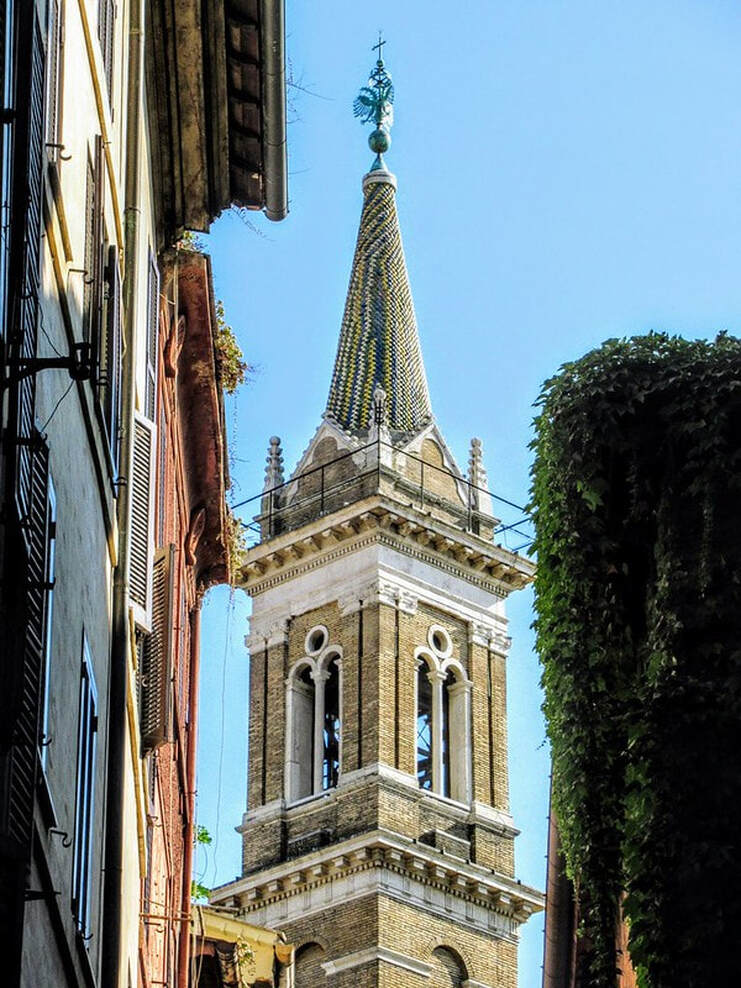
Bell Tower
The church's campanile (bell tower), with its poly-chromatic spire, is one of the most striking in Rome. It was designed by Sansovino and is crowned with a bronze double-headed eagle, the symbol of the Hapsburg Empire. The latter was added in the 19th century.
Nave

Sanctuary
Santa Maria dell' Anima is an example of a Hallenkirche, a style of church in which the aisles are the same height as the nave.

The 'Emperor' Window (det.)
In honour of the unification of Germany in 1870, the interior was re-fitted between 1875 and 1882. Much of the new decoration, including the stained glass, is the work of Ludovico Seltz (1844-1908), a Roman painter of German ancestry.
Sanctuary

High Altar
The sumptuous decoration of the sanctuary was designed by the architect Paolo Posi (1708-76). The painting of the Holy Family with Saints (1522), over the high altar, is the work of Giulio Romano (c.1499-1546), a pupil of Raphael. The words above the painting are from the Book of Isaiah: ECCE VIRGO / CONCIPIET / ET PARIET FILIUM (Behold, a virgin shall conceive, and bear a son).

Double-headed Hapsburg Eagle with the Virgin and Child Flanked by Two Souls
The altar is crowned with a double-headed eagle flanked by allegorical statues of Charity and Fortitude. The eagle holds the Virgin and Child with two souls. It is flanked by a pair of reclining statues, personifications of Charity and Fortitude.
The two paintings above the high altar are by Ludovico Seitz and depict the birth of the Virgin Mary and her death.
Funerary Monuments

Funerary Monument to Pope Adrian VI
The sanctuary is the final resting place of Pope Adrian VI (r. 1522-23), a Dutchman from Utrecht, who was the last non-Italian pope until the election, almost 500 years later, of John Paul II (r. 1978-2005). His funerary monument was designed by Baldassare Peruzzi (1481-1536) and executed by Angelo di Mariano (1491 - c.1540, known also as Michelangelo Senese, with help from Niccolò Pericoli (1497-1550), better known as il Tribolo. The female figures personify the four cardinal virtues, while the bas-relief depicts the pope's entry into Rome.

Bas-relief
An inscription laments: PROH DOLOR QVANTVM REFERET IN QVAE TEMPORA VEL OPTIMI CVIVSQVE VIRTVS INCIDAT (Alas, how important, even for the best of men, are the times in which he finds himself). Adrian VI, and the even shorter-reigning Marcellus II (r. April 9th-May 1st, 1555), are the only popes of the modern era to have retained their own names.

Funerary Monument of Prince Karl Friedrich of Jülich-Cleves-Berg
On the opposite side of the sanctuary is the funerary monument to Prince Karl Friedrich of Jülich-Cleves-Berg, who died in the Holy Year of 1575 while on a pilgrimage to Rome. He was 19 years old. The monument was created between 1575 and 1579 by three Flemish sculptors: Nicolas d’Arras, Gillis van den Vliete, and Pierre de la Motte. The large marble bas-relief depicts The Last Judgement.

Funerary Monument to Georg Meisel
There is a fine array of funerary monuments in the body of the church. My favourite is the elaborately carved cenotaph of Georg Meisel of Bamberg (1626/7-1710), which faces the sanctuary. There is no name only a three-word inscription in Latin: VIVENS MORI MEMOR (Live remembering that you will die).
- Home
- Walking Tours
- Contact
- Blog
- Cathedral
- Popes: 1417-Present
-
St Peter's Basilica
- Altars
- Baldacchino
- Chair of St Peter
- Chapel of the Baptistery
- Chapel of the Blessed Sacrament
- Chapel of the Choir
- Chapel of the Pietà
- Crossing >
- Dome
-
Monuments
>
- Countess Matilda of Canossa
- Maria Clementina Sobieska
- Queen Christina of Sweden
- Pope Innocent VIII
- Pope Paul III
- Pope Gregory XIII
- Pope Gregory XIV
- Pope Leo XI
- Pope Urban VIII
- Pope Alexander VII
- Pope Clement X
- Pope Innocent XI
- Pope Alexander VIII
- Pope Innocent XII
- Pope Benedict XIV
- Pope Clement XIII
- Pope Pius VI
- Pope Pius VII
- Pope Leo XII
- Pope Pius VIII
- Pope Gregory XVI
- Pope Pius X
- Pope Benedict XV
- Pope Pius XI
- Pope Pius XII
- Pope John XXIII
- The Stuarts
- Mosaics
- Nave
- Portico >
- Statue of St Peter
- Statues of Founder Saints
- Transept
- Tribune
- St Peter's Square
-
Vatican Museums
- Borgia Apartment
- Braccio Nuovo
- Cappella Niccolina
- Courtyard of the Pinecone
- Gallery of the Candelabras
- Gallery of the Maps
- Gallery of the Tapestries
- Greek Cross Hall
- Picture Gallery
- Pius-Clementine Museum
- 'Raphael' Tapestries
- Room of the Immaculate Conception
- Sala di Costantino
- Sala dei Chiaroscuri
- Stanza della Segnatura
- Stanza di Eliodoro
- Stanza dell' Incendio
- Sistine Chapel
-
Fountains
- A Miscellany of Fountains
- Trevi Fountain
- Bernini's Fountains
- Fontana della Barcaccia
- Fontana della Peschiera
- Fontana Sallustiana
- Fountain in Piazza Colonna
- Fountain in Piazza delle Cinque Scole
- Fountain in Piazza dell' Aracoeli
- Fountain in Piazza Nicosia
- Fountain in Piazza di S.M. in Trastevere
- Fountain of Moses
- Fountain of Neptune
- Fountain of Ponte Sisto
- Fountain of the Acqua Paola
- Fountain of the Bees
- Fountain of the Cannonball
- Fountain of the Frogs
- Fountain of the Four Rivers
- Fountain of the Goddess Roma
- Fountain of the Lateran Obelisk
- Fountain of the Little Barrel
- Fountain of the Mask
- Fountain of the Moor
- Fountain of the Naiads
- Fountain of the Pantheon
- Fountains of Piazza Farnese
- Fountains of Piazza del Popolo
- Fountain of Piazza del Viminale
- Fountain of Piazza Mazzini
- Fountain of Ponte Sisto
- Fountain of the Porter
- Fountain of the Seahorses
- Fountains of St Peter's Square
- Fountain of the Triton
- Fountain of the Tritons
- Fountain of the Tureen
- Fountain of the Turtles
- Fountains of the Two Seas
- Fountains of Valle Giulia
- Four Fountains
- Rioni Fountains
- Street Fountains
- Venice Marries the Sea
- On This Day in Rome
-
Churches
- Top Ten Churches
- Map: Churches of Rome
- Churches by Rione
- Cosmatesque Pavements
- Deconsecrated Churches
- Funerary Monuments
- Little-known Churches
- Stations of the Cross
- 19th Century Churches >
- 20th Century Churches
- Chiesa dei Re Magi
- Chiesa del Gesù >
- Chiesa dell' Annunziatella
- Chiesa di Gesù e Maria
- Chiesa Nuova
- Domine Quo Vadis
- Lateran Baptistery
- Nostra Signora del Sacro Cuore
- S. Agata dei Goti
- S. Agata in Trastevere
- S. Agnese fuori le Mura
- S. Agnese in Agone
- S. Agostino
- S. Alessio
- S. Anastasia al Palatino
- S. Andrea al Quirinale
- S. Andrea della Valle
- S. Andrea delle Fratte
- S. Angelo in Pescheria
- S. Anna dei Palafrenieri
- S. Antonio dei Portoghesi
- S. Apollinare
- Ss. Apostoli
- S. Balbina
- S. Barbara dei Librai
- S. Bartolomeo all' Isola
- S. Benedetto in Piscinula
- S. Bernardo alle Terme
- S. Bibiana
- S. Brigida
- S. Carlo ai Catinari
- S. Carlo al Corso
- S. Carlo alle Quattro Fontane
- S. Caterina a Magnanopoli
- S. Caterina dei Funari
- S. Caterina da Siena
- S. Cecilia in Trastevere
- Ss. Celso e Giuliano
- Ss. Claudio e Andrea
- S. Clemente >
- Ss. Cosma e Damiano
- S. Crisogono
- S. Costanza
- S. Croce in Gerusalemme >
- Ss. Crocifisso
- Ss. Domenico e Sisto
- S. Dorotea
- S. Eligio dei Ferrari
- S. Eusebio
- S. Eustachio
- S. Francesco a Ripa >
- S. Francesca Romana
- S. Giacomo in Augusta
- S. Giorgio in Velabro
- S. Giovanni a Porta Latina
- S. Giovanni Decollato
- S. Giovanni dei Fiorentini
- S. Giovanni della Pigna
- Ss. Giovanni e Paolo
- S. Girolamo dei Croati
- S. Girolamo della Carità >
- S. Giuliano dei Fiamminghi
- S. Giuseppe dei Falegnami
- S. Gregorio della Divina Pieta
- S. Gregorio Magno
- S. Ignazio di Loyola
- S. Isidoro
- S. Ivo alla Sapienza
- S. Lorenzo fuori le Mura
- S. Lorenzo in Damaso
- S. Lorenzo in Lucina
- S. Lorenzo in Miranda
- S. Lorenzo in Panisperna
- S. Lucia del Gonfalone
- S. Luigi dei Francesi >
- Ss. Luca e Martina
- Ss. Marcellino e Pietro
- S. Marcello al Corso
- S. Marco
- S. Maria ad Martyres
- S. Maria ai Monti
- S. Maria Annunziata
- S. Maria degli Angeli
- S. Maria dei Miracoli
- S. Maria del Popolo >
- S. Maria dei Sette Dolori
- S. Maria del Priorato
- S. Maria della Concezione
- S. Maria della Consolazione
- S. Maria della Pace >
- S. Maria della Scala
- S. Maria della Vittoria >
- S. Maria delle Grazie
- S. Maria dell' Anima
- S. Maria dell' Orazione e Morte
- S. Maria dell' Orto
- S. Maria di Loreto
- S. Maria in Aracoeli >
- S. Maria in Aquiro
- S. Maria in Campitelli
- S. Maria in Campo Marzio
- S. Maria in Cosmedin
- S. Maria in Domnica
- S. Maria in Monserrato
- S. Maria in Montesanto
- S. M. in Monticelli
- S. Maria in Traspontina
- S. Maria in Trastevere >
- S. Maria in Trivio
- S. Maria in Via
- S. Maria in Via Lata
- S. Maria Maddalena
- S. Maria Maggiore >
- S. Maria sopra Minerva >
- S. Maria Scala Coeli
- S. Martino ai Monti
- Ss. Nereo e Achilleo
- S. Nicola da Tolentino
- S. Nicola dei Lorenesi
- S. Nicola in Carcere
- Ss. Nome di Maria
- S. Onofrio al Gianicolo
- S. Pancrazio
- S. Pantaleo
- S. Paolo alla Regola
- S. Paolo alle Tre Fontane
- S. Paolo fuori le Mura
- S. Pasquale Baylon
- S. Pietro in Montorio
- S. Pietro in Vincoli
- S. Prassede
- S. Prisca
- S. Pudenziana
- Ss. Quattro Coronati
- S. Rita da Cascia
- S. Rocco
- S. Saba
- S. Sabina >
- S. Salvatore in Lauro
- S. Salvatore in Onda
- S. Sebastiano fuori le Mura >
- S. Silvestro in Capite
- S. Sisto Vecchio
- S. Spirito in Sassia
- S. Stanislao dei Polacchi
- S. Stefano Rotondo
- Ss Stimmate di San Francesco
- Ss. Sudario dei Piemontesi
- S. Susanna
- S. Teodoro
- Ss. Trinità degli Spagnoli
- Ss. Trinità dei Pellegrini
- Ss. Trinità di Monti
- Ss. Vincenzo e Anastasio a Trevi
- Ss. Vincenzo e Anastasio
- S. Vitale
- Cloisters
- Palatine
- Forum
-
Ancient Monuments
- Aqueducts
- Ara Pacis
- Arch of Constantine
- Arch of Drusus
- Arch of Gallienus
- Arch of Janus
- Arch of the Money-Changers
- Aurelian Walls
- Baths of Caracalla
- Baths of Diocletian
- Castel Sant' Angelo
- Catacombs of Domitilla
- Circus Maxentius
- Circus Maximus
- Colosseum
- Column of Marcus Aurelius
- Column of Trajan
- Forum of Augustus
- Forum of Trajan
- Mausoleum of Augustus
- Nymphaeum
- Pantheon
- Ponte Fabricio
- Ponte Milvio
- Ponte Rotto
- Ponte Sant' Angelo
- Porta Maggiore
- Porta San Paolo
- Porta San Sebastiano
- Portico of Octavia
- Pyramid of Cestius
- Temple of Hadrian
- Temple of Hercules
- Temple of Jupiter
- Temple of Portunus
- Theatre of Balbus
- Theatre of Marcellus
- Theatre of Pompey
- Tomb of Caecilia Metella
- Via Appia
-
Obelisks
- 'Minerveo' Obelisk
- 'Flaminio' Obelisk
- 'Matteiano' Obelisk
- 'Lateran' Obelisk
- 'Dogali' Obelisk
- 'Macuteo' Obelisk
- 'Solare' Obelisk
- 'Vatican' Obelisk
- 'Agonalis' Obelisk
- 'Sallustiano' Obelisk
- 'Quirinale' Obelisk
- 'Esquiline' Obelisk
- 'Pinciano' Obelisk
- 'Mediceo' Obelisk
- 'Torlonia' Obelisks
- 'Mussolini' Obelisk
- 'Marconi' Obelisk
-
Mosaics
- Sant' Agnese fuori le Mura
- Santa Cecilia in Trastevere
- San Clemente
- Santa Costanza
- Santa Francesca Romana
- San Lorenzo fuori le Mura
- San Marco
- Santa Maria in Domnica
- Santa Maria in Trastevere
- Santa Maria Maggiore
- Santa Prassede >
- Santa Pudenziana
- Santo Stefano Rotondo
- San Teodoro
- San Venanzio
- Santi Cosma e Damiano
- Santi Nereo e Achilleo
- Palaces
- Galleries & Museums
- Piazzas
-
Miscellaneous
- A Calendar of Saints
- A Literary Tour of Rome
- A Roman Bestiary
- Antico Caffè Greco
- Babington's Tea Rooms
- Barberini Bees
- Borromini & the Baroque
- Column of the Immaculate Conception
- Domes
- Equestrian Statues
- EUR >
- Fasces
- Flood Plaques
- Galleria Sciarra
- House of the Owls
- Images of the Annunciation
- Jewish Ghetto
- Jubilee & Four Holy Doors
- Knights of Malta
- Mapping Rome
- Mithraism
- Old Photographs of Rome
- Ponte Sisto
- Porta Pia
- 'Protestant' Cemetery
- Quartiere Coppedè
- Romulus & Remus
- Santo Spirito in Sassia
- Scala Santa
- Spanish Steps
- Street Shrines
- Swiss Guards
- 'Talking' Palaces
- 'Talking' Statues
- Tiber Island
- Train of Pope Pius IX
- Views of Rome
- Villa Borghese
- Vittoriano
- On This Day in Italy
- The Bernini Trail
- Baroque Sculptors
-
Florence
- A Literary Tour
- Anna Maria Luisa: Last of the Medici
- Canons' Palace
- Casa-Galleria Vichi
- Column of Justice
- Column of St Zenobius
- Cosimo I de' Medici
- Cosimo II de' Medici
- Costanza Bonarelli
- David With Fig Leaf
- Elizabeth Barrett Browning
- Equestrian Statue of Cosimo I de' Medici
- Equestrian Statue of Ferdinando I de' Medici
- Festina Lente
- Flood Plaques
- Fontana del Bacchino
- Fontana dei Puttini
- Fountain of Neptune
- Fountains of the Marine Monsters
- Gian Gastone de' Medici
- Girolamo Savonarola
- Images of the Annunciation
- Little Devil
- Monument to Cellini
- Palazzo Bartolini-Salimbeni
- Palazzo Bianca Cappello
- Palazzo Fenzi
- Palazzo Viviani
- Perseus and Medusa
- Piazza Santa Maria Novella
- Pope Leo XI
- Porta della Mandorla
- Rape of the Sabine Woman
- Santa Maria Novella
- Statue of Dante
- Theft of the Century
- Torre del Arnolfo
- Twelve Good Men
- Villa Gamberaia
- Wheel of the Innocents
- 'Wine Windows'
- Lazio
- Tuscany
-
Venice
- 421: Foundation of Venice
- Acqua Alta
- Bartolomeo Colleoni
- Barque of Dante
- Caffè Florian
- Daniele Manin
- Flagpoles
- Giustina Rossi
- Gondolas
- Harry's Bar
- Henry James
- House of Three Eyes
- Island of Lace
- King Victor Emmanuel II
- Map of Venice
- Martinmas
- Master of the House
- Palazzo Contarini Fasan
- Ponte Borgoloco
- Ponte Chiodo
- Punta del Dogana
- Scacciadiavoli
- Shrine of St Lucia
- Sior Antonio Rioba
- The 'Book Shitter'
- The Lion's Mouth
- Tommaso Rangone
- Torcello
- Venus
- 'Viennese Oranges'
- Wellheads
- Winged Lions